


I have come across this film not through deliberate intention but through the gentle unruliness of a day spent wandering London with a friend. The city was unusually soft for November. The kind of light that makes the familiar streets feel briefly unguarded. We had stopped to watch the King’s ceremonial guard outside Downing Street, a spectacle choreographed to project continuity and control. Yet even there, in the choreography of state power, something broke. A man pulled another from his bicycle and struck him. Sudden violence in a place where violence is meant to be historical, contained, performed. We offered ourselves as witnesses. And for the rest of the afternoon, the moment hung over us like a shadow we could not quite name.
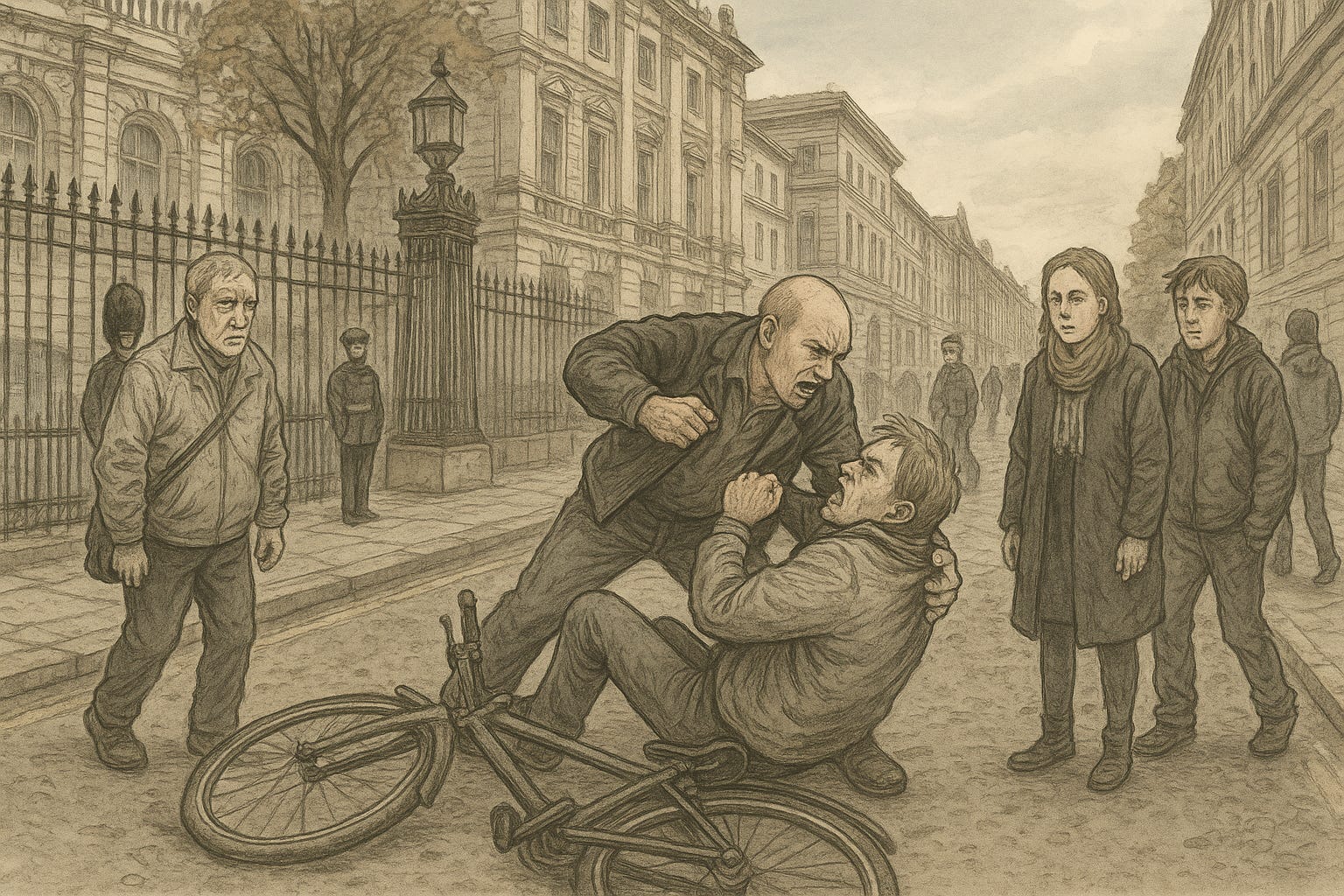
We walked onward. Trafalgar Square. Leicester Square. Tea and lavender cake. London lively and indifferent as always. And we ended in a cinema, intending one film but finding another. A choice made by timing and availability, the accidental kind that leaves traces. The film Bugonia unfolded in front of us, and something about its strangeness, its brittle humour, its cruelty, seemed to resonate with the earlier scene in Whitehall. The world of the film is absurd, paranoid, violent, but also heartbreakingly recognisable. It depicts people who are desperate to make sense of the harm done to them yet trapped inside stories that distort reality until reality can no longer be reached.
The narrative of two young men convinced that a corporate executive is an alien infiltrator is, at first glance, a satire of conspiracy culture. But what sits beneath is not mockery. It is a study of loneliness, dispossession, and the hunger for explanation in a world that too often leaves people unseen and unheld. The film does not ask us to sympathise with the violence committed. But it does ask us to look at where that violence grows. The soil is familiar. Economic precarity. Abandonment. Corporate power that becomes so normalised we forget to call it power at all. Communities stretched thin. Men raised to believe that pain must be hidden until it erupts.
Teddy, the central character, is not simply delusional. He is someone who has endured personal and structural wounds that have not been witnessed with care. His mother has been harmed by pharmaceutical intervention packaged as care. He works in an environment where exploitation is framed as opportunity. His grief is untreated. His anger is unparented. He has no language for suffering except extremity. And so he seeks meaning where meaning feels otherwise inaccessible. The conspiracy he constructs is grotesque, yes, but it is also coherent within a life where institutions have repeatedly failed to honour human dignity.
The film presents a corporate executive who becomes the object of Teddy’s projected cosmology. She is, by his logic, a representative of a species bent on humanity’s annihilation. And the disturbing turn, the twist that unsettled the entire cinema into murmured disbelief, is that the narrative he conjures is revealed to be true. She is an alien. The world is indeed being monitored and judged. Humanity is deemed incapable of sustaining its own home without destroying it. And the aliens choose to end the human species entirely, preserving only the animals, the bees, the living world rendered voiceless under our stewardship.
This reversal is not triumph. It is tragedy. Because what the film exposes is that neither delusion nor truth absolves the pain that produced them. Teddy’s belief is catastrophic, but the world that shaped him is also catastrophic. The film refuses the comfort of locating evil solely in madness or in cosmic intervention. Instead, it points to something more uncomfortable. Human beings have created systems in which we cannot care for each other adequately. We have normalised abandonment. We have accepted violence in forms that are quiet, distributed, bureaucratically sanitised.
At the cinema’s end, when the lights came up and no one moved, there was a shared disorientation. People who had not spoken to each other shared glances, small remarks. An unspoken question passed between us. What are we doing to each other? And what does it mean that this story, however fantastical, felt not merely possible but recognisable?
The day had begun with a sudden act of physical violence. A man striking another in the street. Something irrational rising to the surface. And here was the same pattern on a grander scale. A world where emotional rupture is not treated but weaponised. A world where institutions present themselves as rational while perpetuating harm. A world where people cling to explanation, even when explanation consumes them.
The film does not tell us what to think. It simply asks us to look. To look at what we have allowed to become normal. To ask whether we are capable of building structures of care rather than structures of harm. It suggests that the end of humanity is not found in alien intervention, but in our inability to reckon with our own grief and responsibility.
And perhaps that is why it kept us seated long after the credits faded. It is easier to imagine the world ending than to imagine the world changing. Yet the film insists, quietly and without sentimentality, that change is the only humane alternative.
If we are to survive, we must learn to witness each other, not as threats, not as instruments, not as abstractions, but as fragile, complicated beings in need of dignity and care. The work begins in moments as small as Whitehall. A bicycle. A fist. A choice to step forward and say I saw what happened and I will not look away.